
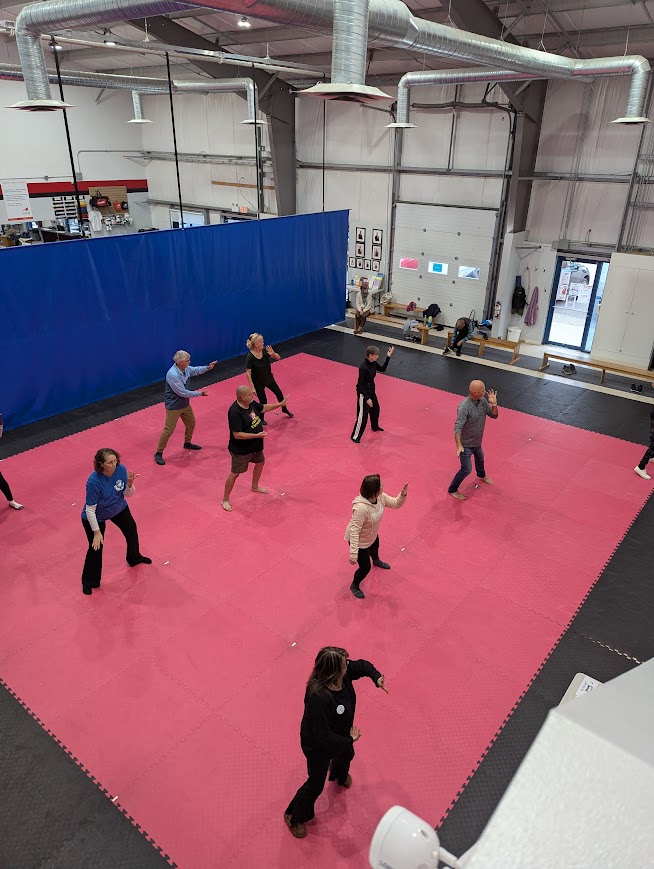
What if your Tai Chi class could tell you more about your wellness than you realized?
At our recent Wine Country Tai Chi Society Wellness Retreat, we spent a weekend exploring that question. We moved, paused, noticed, experimented, laughed, learned, and discovered just how much information the body can provide when we give ourselves time to listen.
One of the most important messages from the weekend was simple:
Your wellness plan can be in the palm of your hands.
The exercises and ideas we explored were not intended to add another complicated list of things we “should” be doing. Instead, they offered ways to become more aware of what we are already doing—how we sit, stand, breathe, step, reach, turn, hold tension, respond to stress, and move through our day.
That awareness may be one of the greatest gifts Tai Chi provides.
What Is Your Posture Telling You?
We often think about posture as something we need to correct: shoulders back, stand straight, head up.
During the retreat, we explored posture differently.
Remembering that a straight and lifted posture is the normal position, we lifted our ears to find the lift and the extension of the chest to naturally support breathing. We began by noticing tension and ease.
Sitting forward on a chair so the pelvis can be dynamically moving with every action in the body, we realized the value of having the ears over the shoulders rather than forward (like when driving a car or sitting at a computer or reading). We noticed imbalance in shoulder levels, hip levels, and ankles. Where is the weight travelling through the feet? Is one shoulder sitting differently from the other? Where are we holding unnecessary tension? What happens when we sit first and remove some of the demands of standing? How does our awareness change while seated?
Suddenly, posture becomes information.
This was one reason the seated exercises were so valuable throughout the weekend. Sitting allowed participants to explore movements without first having to manage balance, weight transfer and all the muscular demands of standing.
We could feel.
We could compare.
We could become curious.
Then, when we stood again, there was something new to notice.
This is a wonderful principle to bring back to regular Tai Chi classes. Before worrying about whether a movement looks “right,” consider asking:
What do I feel before I begin? What changes when I move? What do I notice afterwards?
Those three questions can transform a familiar exercise into a completely different learning experience.
Discovering the Connections Within the Body
Another area that generated considerable interest was our exploration of the meridians and their relationships with muscles, organ systems and the Five Elements.
For some participants, tracing the meridians created a new way of thinking about familiar Tai Chi movements. Spirals, extensions and connections from the feet through the torso and into the hands were no longer simply choreography for a movement pattern.
They became an opportunity to consider the body as an interconnected system.
This is also where my background in Touch for Health® adds another dimension to our Tai Chi explorations. Touch for Health provides a framework for exploring relationships between muscles, meridians, organ systems and elements.
Once we begin to recognize these relationships, we can become curious about our movement patterns.
Why does one movement feel effortless while another feels restricted?
Why might a shoulder repeatedly rise?
Why does turning feel different in one direction?
What changes when the feet are more grounded?
Rather than judging these differences, we can use them as information.
Tai Chi gives us an extraordinary laboratory for this kind of discovery because we repeat movements slowly enough to notice subtle changes.
Why Slower Can Teach Us More
I shared a Tai Chi Wellness video collection with retreat participants that was originally recorded in 2018. I joked that we were moving considerably faster in those videos—not because we are older now, but because we have continued to learn about repatterning!
There is something important in that observation.
When we slow a movement down, we have more opportunity to notice where effort begins, where tension appears, where balance shifts and where movement becomes easy.
Rather than trying to keep up with a recording, choose one exercise. Learn the basic movement. Then turn the video off.
Slow it down.
Explore it.
Repeat it.
Notice what changes.
The goal does not have to be doing more Tai Chi. Sometimes the most valuable practice is doing less movement with more awareness.
The Sabre Gave Us Another Perspective
Our Sabre workshop offered a particularly powerful example of this.
Participants explored how changing the position of the hands could alter tension elsewhere in the body. We investigated the spiralling nature of Sabre movements and how those spirals can travel through much more than the arms.
Check out our Facebook post here!
A movement that appears to be about the Sabre may actually provide an opportunity to explore the hands, wrists, shoulders, spine, hips, legs, feet, attention and intention simultaneously.
This is one reason learning different aspects of the Moy Tai Chi system can be so valuable.
Tai Chi, Sabre, Lok Hup, seated practice and standing practice do not necessarily need to be viewed as separate activities. Each can give us another way of experiencing and understanding ourselves.
One practice may reveal something that another practice helps us integrate.
What Are Your Habits Practising?
As we approach the final months of 2026, this may be a wonderful time to consider your own wellness plan.
We often think about habits as things we deliberately establish: exercise three times a week, drink more water, meditate, eat differently or go to bed earlier.
But we have many other habits that we rarely put on a wellness checklist.
How do you sit at your computer?
What happens to your shoulders when you are stressed?
Do you hold your breath when concentrating?
Do you always stand on the same leg?
Do you rush through movements because that has become your normal pace?
What thoughts accompany something that feels difficult?
Even tension can become habitual.
This changes the question from “What healthy habit should I add?” to something potentially much more revealing:
“What am I already practising every day?”
Our bodies become very good at the patterns we repeat.
Tai Chi gives us an opportunity to explore those patterns deliberately and, when appropriate, introduce new possibilities.
Building Your Own Blue Zone
At Wine Country Tai Chi Society, we have been exploring the idea of Blue Zones and what contributes to longevity, vitality, connection and quality of life.
Perhaps we can think about creating a personal Blue Zone as well.
It does not have to exist somewhere else in the world.
It can begin with how we move today.
It can be the friendships and laughter we share at class. It can be continuing to learn something new. It can be taking time to breathe and move. It can be choosing activities that give us purpose. It can be recognizing tension earlier and having tools available to respond.
And sometimes it can simply be taking a few minutes to do Don Yu’s, trace the meridians, practise Commencement, explore a seated movement or pick up the Sabre and feel a spiral travel through the body.
Small practices become powerful when they become part of how we live.
Take One Discovery Back to Class
If you attended the Wellness Retreat, you do not need to remember everything we explored.
Choose one discovery.
Perhaps you became fascinated by the meridians. Perhaps seated Tai Chi changed how you experienced a movement. Perhaps you noticed a relationship between a muscle and your posture. Perhaps the Sabre helped you understand spiralling movement differently. Perhaps you discovered something through the gaits, hyoid bone or cloacals.
Bring that one idea into your next class.
Explore it for several weeks.
Notice what changes.
And if you did not attend the retreat, you can begin exactly where you are. Choose one familiar Tai Chi movement and become curious about it again.
Continue Exploring
There are several resources available for anyone who would like to continue the discoveries we began during the retreat.
The Tai Chi Wellness YouTube Playlist includes exercises and explorations related to meridians, seated Don Yu’s, Commencement, sensing, energy gates and other Tai Chi wellness concepts.
Free BioEnergetic Essentials resources are also available through CanBeWell.org, including simple techniques such as the foot rub, switches and Emotional Stress Release points that can be explored before class or as part of a personal wellness routine.
For those wishing to explore more deeply, there are opportunities through the Greenwell Center for Holistic Health in Touch for Health®, Movement and Music, Movement and Music 2 with Artfilled Wellness: Frequency in Motion Volume 1, Tai Chi Skill Building, and the Movement Mastery Program.
But wherever you choose to continue, remember that the resource itself is not the destination.
The discovery happens when you experience it in your own body.
As we move toward the end of 2026, perhaps your wellness plan does not need to begin with a long list of resolutions.
Begin by noticing.
What supports your vitality?
What drains it?
Which habits create greater ease?
What has your Tai Chi practice been trying to show you?
Then choose one small thing to explore.
Your next Tai Chi class might be much more than another opportunity to practise the set.
It might be an opportunity to discover something new about yourself.
The Journey is the Reward.
— Michelle B. W. Greenwell, PhD, CIH BioEW