
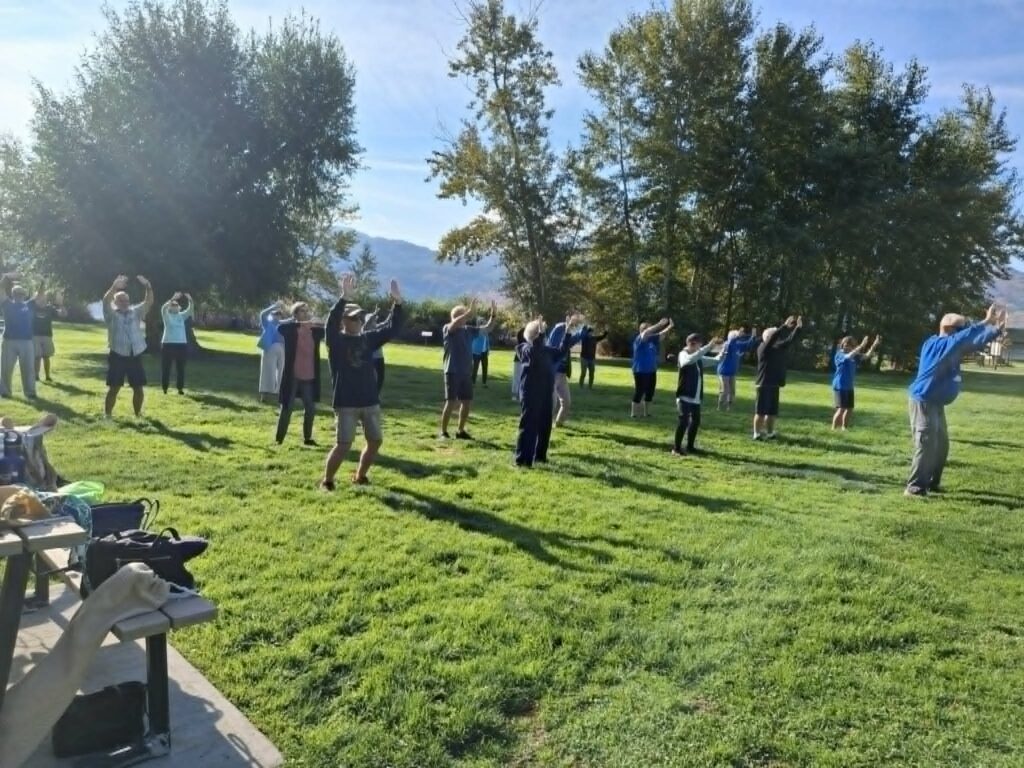
Fall is a wonderful time to organize your self-care schedule—and your weekly Tai Chi practice may be doing much more for your future wellbeing than you realize.
At the Wine Country Tai Chi Society, we often talk about Tai Chi as a practice for balance, relaxation, movement, breathing and community. But increasingly, research is helping us understand just how important those regular hours of movement may become as we age.
A fascinating study published in Aging Cell compared older adults who had practised Tai Chi for many years with older adults who did not practise Tai Chi and a group of healthy younger adults.
The long-term Tai Chi group had practised for an average of approximately 24.5 years. Researchers assessed six areas of physical function, including balance, mobility, grip strength, walking speed, functional reach and lower-body power. For most of these measures, the long-term Tai Chi practitioners performed better than their age-matched peers who did not practise Tai Chi—and their results were generally closer to those of the younger adults.
That is an exciting idea to consider as we begin another fall session. Online registration is open here, or join our open house dates.
Tai Chi and the Possibility of Healthy Aging
The researchers concluded that long-term Tai Chi training was associated with higher levels of physical function in older adults, suggesting a potential preventive healthy-aging effect. Because the long-term comparison was observational, we can’t say Tai Chi alone caused these differences. The study’s six-month randomized portion also did not find significant changes in these already healthy, active adults, reminding us that the most interesting story may be the accumulation of practice over years.
And perhaps that is the most important message for our members:
Wellbeing is something we practise.
We don’t necessarily come to Tai Chi looking for dramatic changes from a single class. We develop a habit. Week after week, we practise shifting our weight, organizing our posture, strengthening our legs, moving through greater ranges, coordinating the whole body and bringing awareness to our breath.
Over months and years, those small practices become part of how we move through life.
And Then There Is the Breath
Recently, one of our members in her mid-80s went for a lung function test. Her ability to breathe deeply was so impressive that the nurse reportedly had to double-check what she was seeing.
We can’t attribute an individual’s lung-test results specifically to Tai Chi, but the story beautifully illustrates something we experience in class: breathing is trainable.
Tai Chi invites us away from the small, guarded breathing that can accompany tension and toward relaxed posture, an open chest and fuller, coordinated breathing.
Breathing and movement also work together to support circulation and the movement of lymph. Rather than thinking of a deep breath as a guarantee against illness, we can think of healthy respiratory function, regular movement and circulation as important parts of maintaining overall resilience and physical wellbeing.
This Is Where Our Blue Zone Initiative Comes Alive
Our Wine Country Tai Chi Blue Zone initiative asks us to consider something larger than exercise: What are the everyday conditions that help people flourish as they grow older?
Regular movement matters. But so do purpose, belonging, social connection and routines that make healthy choices easier to sustain.
That is exactly what a Tai Chi community can offer.
When you know that Monday and Thursday morning are your Tai Chi mornings—or that Tuesday and Thursday evening belong to your practice—you don’t have to continually decide when you are going to take care of yourself.
It is already in your calendar.
You arrive. Your friends are there. You move together. You breathe. You learn something new. You laugh. You challenge your coordination and balance. And then you return the following week and do it again.
That is how a wellness habit begins to become a wellness lifestyle.
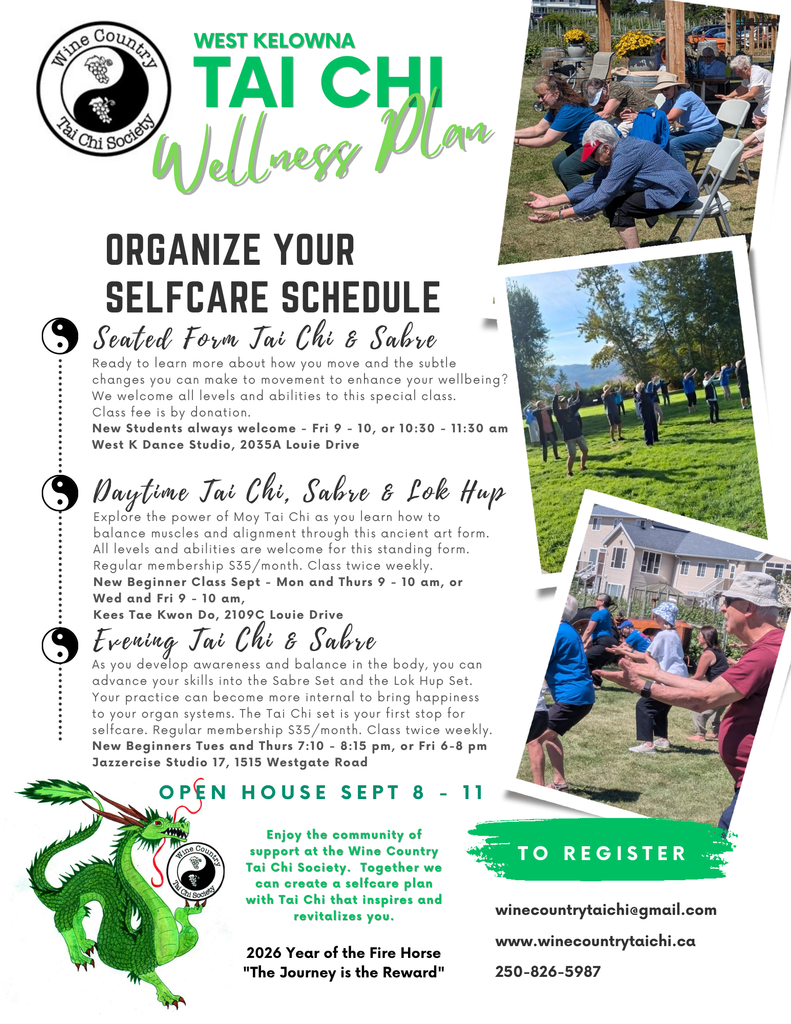
Come and Try Tai Chi: Open House September 8–11
This September, we’re inviting our West Kelowna community to experience it for themselves.
Wine Country Tai Chi Society’s Open House runs September 8–11. Come into a class, meet our instructors and members, experience some of the movements, ask questions and discover which class might fit into your fall self-care schedule.
Our fall program includes:
- Seated Form Tai Chi & Sabre — Fridays at West K Dance Studio, with options at 9:00–10:00 a.m. or 10:30–11:30 a.m. This inclusive class welcomes different levels of mobility and ability.
- Daytime Moy Tai Chi, Sabre & Lok Hup — beginner options include Monday and Thursday, 9:00–10:00 a.m., or Wednesday and Friday, 9:00–10:00 a.m. at Kees Tae Kwon Do.
- Evening Tai Chi & Sabre — new beginners can join Tuesday and Thursday, 7:10–8:15 p.m., or Friday, 6:00–8:00 p.m. at Jazzercise Studio.
As skills develop, members can explore Tai Chi more deeply and progress into Sabre and Lok Hup, continuing to challenge coordination, balance, whole-body movement and awareness.
Ready to sign up? Click here and register online, ahead of the line up!
Don’t Just Add a Class. Create a Habit.
The research on long-term practitioners gives us something powerful to contemplate. The people in that study didn’t accumulate more than two decades of Tai Chi by thinking about what they might do someday.
At some point, they began.
And then they kept going.
This fall, consider putting your wellbeing into your calendar before everything else fills the spaces.
Choose your class. Choose your days. Create your community. Build the habit.
Your future self may be very glad you did.
Open House: September 8–11, 2026
New students are always welcome.
Contact the Wine Country Tai Chi Society at winecountrytaichi@gmail.com, visit winecountrytaichi.ca, or call 250-826-5987 to learn more.
Research
Ma, Y., Gow, B. J., Song, R., Rist, P. M., Hausdorff, J. M., Lipsitz, L. A., Manor, B., & Wayne, P. M. (2024). Long-term Tai Chi practice in older adults is associated with “younger” functional abilities. Aging Cell, 23(1), e14023.